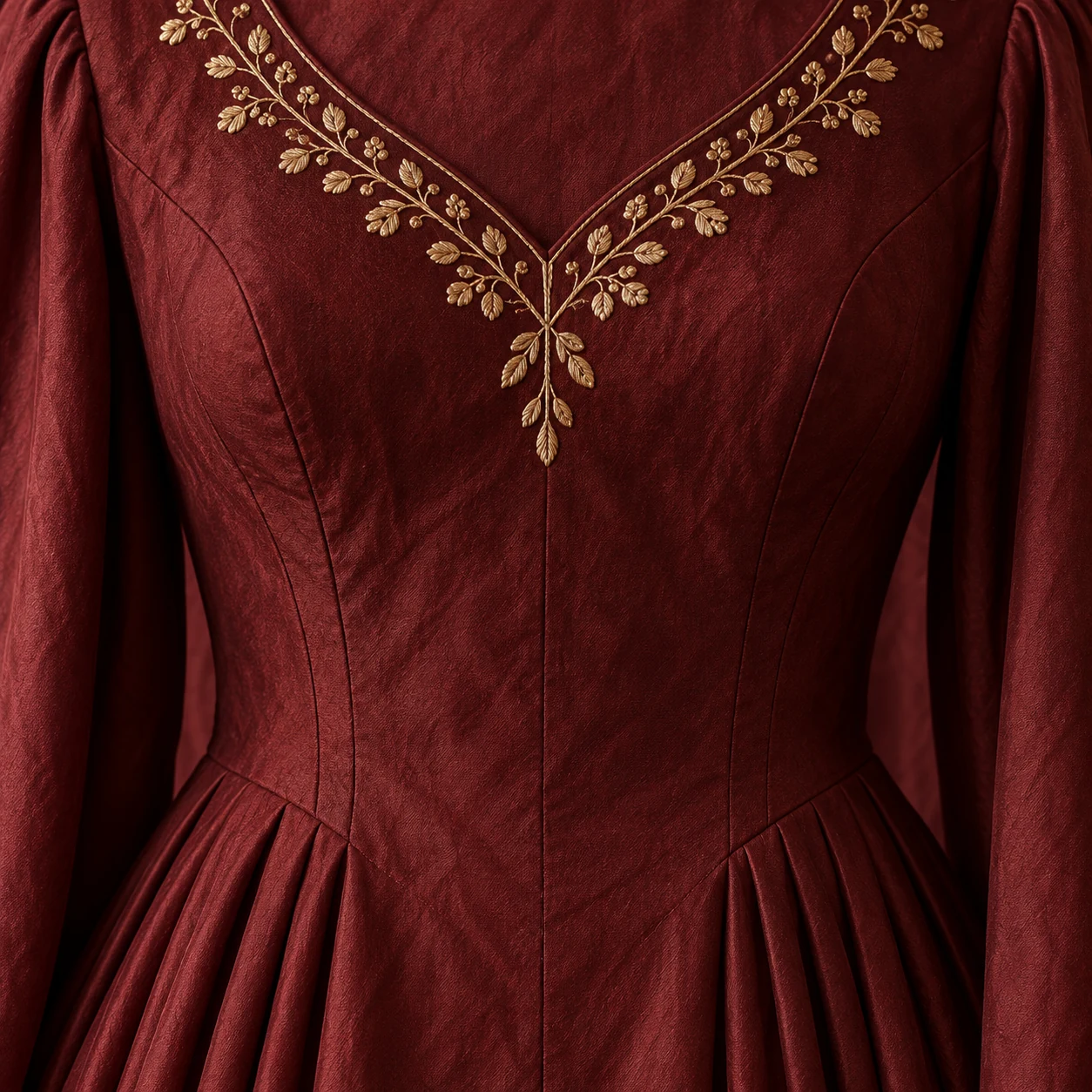
Embroidery is easiest to appreciate close up, but its design role is often clearest from a distance. A motif can frame a neckline, connect a bodice to a skirt or become a small accent at a cuff. Looking at its placement helps you decide what you want the detail to contribute.
Read the placement before the stitch
Start with the complete garment. Where is the strongest concentration of detail, and where does the surface remain quiet? A tapering branch can lead the eye down from the bodice; a hem border can give the skirt an ending. Those choices affect the balance before you notice individual threads or beads.
The V&A's account of Arts and Crafts fashion describes support for handmade production and the promotion of embroidery as a creative practice. It is a useful historical context for considering decoration as a design decision. A contemporary dress still needs its own reasons for where a motif is placed.
Context: V&A — How the Arts and Crafts movement influenced fashion.
Compare repetition with variation
Repeated motifs can create rhythm, while a single element can act as a focal point. Neither is automatically more refined. Ask how the proposed pattern works with the seams and folds. A motif may need to change scale or direction when it travels from a shaped bodice onto a broader skirt.
Look for a clear relationship between the detail and the silhouette. If the neckline already has a strong fold, you may prefer a quieter embroidered surface near it. If the skirt is otherwise simple, a pattern may have more room to develop. Think in terms of relationships, not a fixed amount of decoration.
Use close-ups to ask better questions
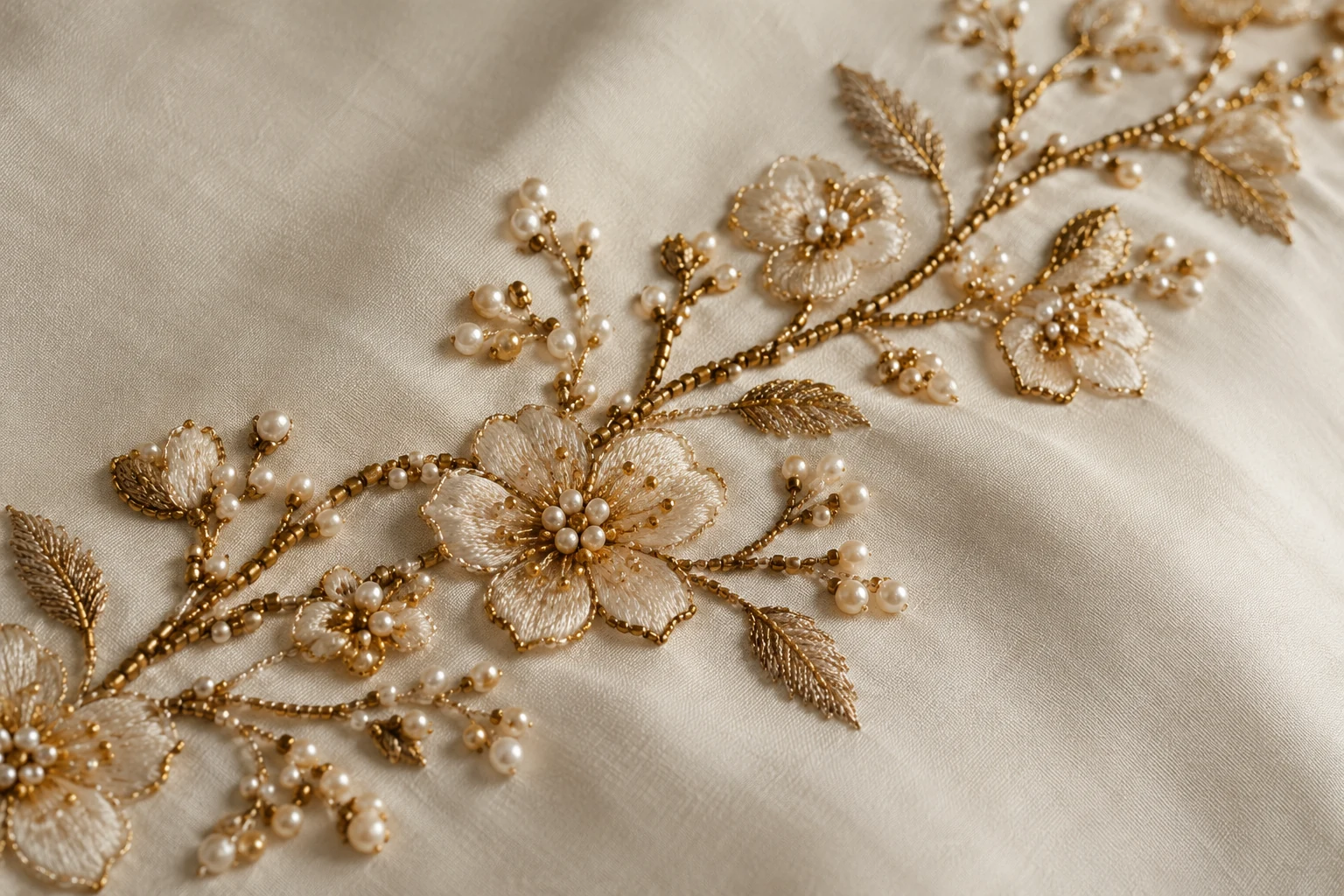
A detail photograph can help you see colour, texture and the way embellishment meets the fabric. It cannot confirm every aspect of construction or how the dress will feel in use. Treat the image as a starting point for questions about the actual proposed piece and the materials involved.
Ask how the embroidered area will be finished and how it should be handled. If beads, pearls or raised threads are important to the design, discuss their care as well as their appearance. Avoid assuming that a richly detailed surface will tolerate the same handling as an unembellished garment.
Give the motif a reason to belong
If you bring a personal reference, explain what it means to you and which parts matter. You may want the feeling of a botanical line rather than an exact flower, or a small repeated element rather than a full pattern. A precise explanation gives the designer room to create a coherent interpretation.
When comparing Farfalla designs, move between the full silhouette and the matching detail view. Notice where the same motif appears in each. Your preferred balance may be a lightly framed neckline, a stronger skirt border or an almost plain surface. The right amount is the amount that supports your intended expression.